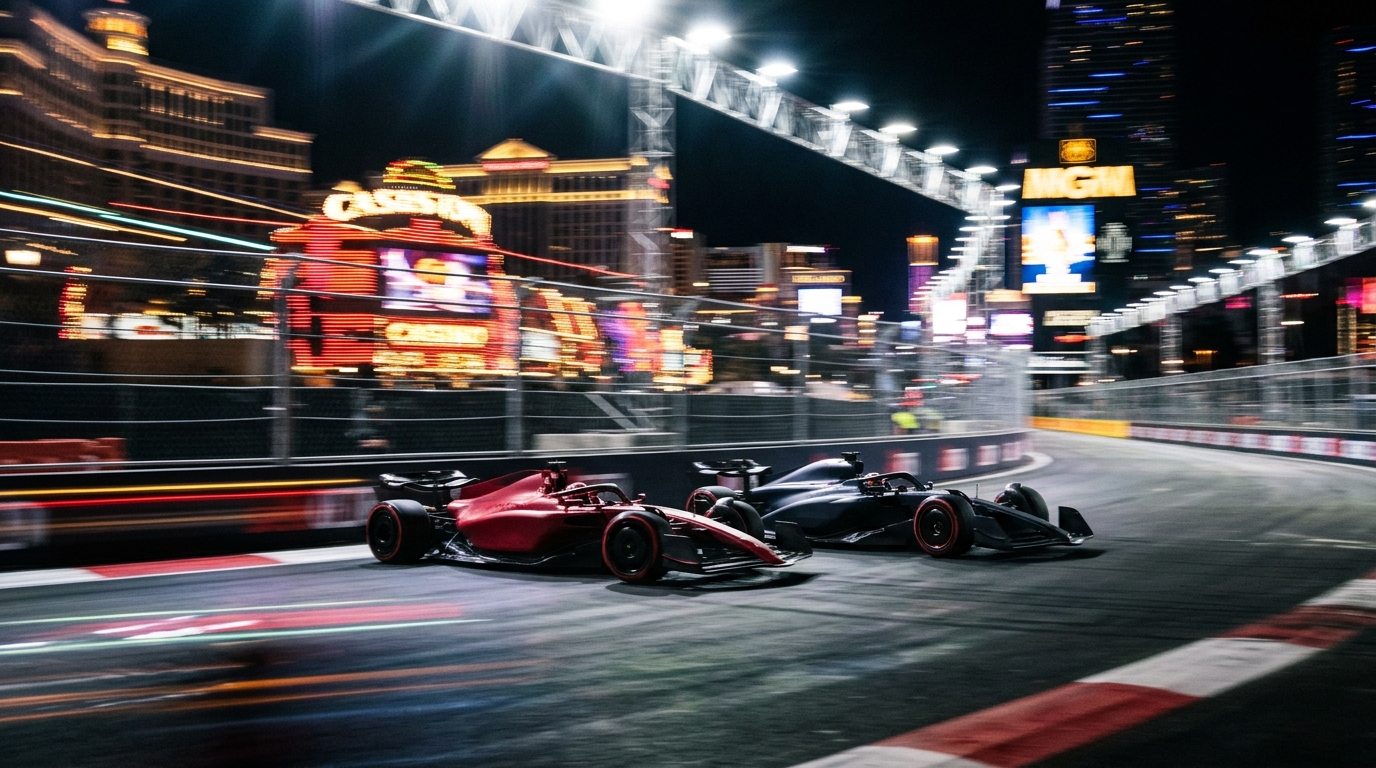
Formula 1 races on street circuits are supposed to reward track position and tire babysitting. Nobody told the 2026 Las Vegas Grand Prix. Under the neon canopy of the Strip, fans watched an old-school slipstreaming free-for-all that produced a staggering 35 lead changes before Red Bull’s Max Verstappen crossed the finish line just 0.639 seconds ahead of McLaren’s Lando Norris to seal his fourth victory of the season.
On a cold desert night where energy management and tow timing mattered as much as outright qualifying pace, Verstappen delivered what The Guardian described as a tactical masterclass—knowing precisely when to surrender a straightaway to recharge battery reserves and when to deploy every kilojoule on the braking zones into Turn 14.
How the 35-Lead-Change Chess Match Unfolded
From the opening laps, it was clear that Vegas’s long, flat-out run down Las Vegas Boulevard had turned the 2026 energy-deployment regulations into a high-speed game of chicken. Leading the pack early actually carried a penalty: punching a hole in the cool Nevada air drained battery deployment faster, turning the race leader into a sitting duck for anyone tucked cleanly inside the slipstream behind.
Instead of burning his reserves defending every half-hearted lunge, Verstappen repeatedly let rivals cycle past on the straightaways, conserving electrical energy while keeping his tires in the narrow operating window. As Formula1.com’s post-race breakdown highlighted, that patience paid off in the closing stint. When Mercedes’ George Russell pushed hard in contention late in the night and clipped the barriers, the disruption scrambled the final-lap order—opening the door for Verstappen to lock down the inside line while Norris surged on the final lap to edge out McLaren teammate Oscar Piastri for second.
| Position | Driver | Team | Key Race Storyline |
|---|---|---|---|
| 1st | Max Verstappen | Red Bull Racing | 4th win of 2026; mastered energy deployment amid 35 lead changes |
| 2nd | Lando Norris | McLaren | Late final-lap surge to finish +0.639s behind Verstappen |
| 3rd | Oscar Piastri | McLaren | Clean, measured drive to seal a double McLaren podium |
| 7th | Lewis Hamilton | Ferrari | Survived spin and 10-second penalty to lead Ferrari points |
| 10th | Charles Leclerc | Ferrari | Dropped to P10 after colliding with Hamilton and drawing 10s penalty |
Ferrari’s Costly Intra-Team Collision
If McLaren walked away beaming over a double podium and Red Bull celebrated clinical execution, Ferrari spent Sunday morning answering uncomfortable questions. Mid-race, teammates Charles Leclerc and Lewis Hamilton made wheel-to-wheel contact while battling through traffic—an incident that instantly turned a promising points haul into damage control.
Stewards handed Leclerc a 10-second time penalty for his role in the clash, dropping the Monegasque driver down to 10th at the checkered flag, as detailed in Crash.net’s full race classification. Hamilton’s night was hardly serene either—the seven-time champion endured both a spin and a separate 10-second penalty—yet his recovery drive back to seventh place salvaged at least modest consolation points for Maranello. In a constructors’ fight where McLaren continues stacking podiums, giving away points through friendly fire stings twice as hard.
Mercedes’ Heartbreak and McLaren’s Quiet Consistency
George Russell’s late wall strike underscored just how unforgiving the Strip remains when drivers chase every last hundredth under the floodlights. For three-quarters of the distance, Russell looked like a genuine contender to spoil Verstappen’s night, trading blows at the sharp end before one misjudgment into the barriers erased Mercedes’ podium bid.
McLaren, by contrast, once again showcased the calm pit-wall discipline that has defined its 2026 campaign. Neither Norris nor Piastri got sucked into reckless early battery duels; both kept their front wings intact through chaotic three-wide braking zones, and Norris timed his final-lap pass to perfection to claim P2 behind Verstappen. As PlanetF1’s post-race analysis noted, Vegas rewarded drivers who thought two laps ahead rather than two corners ahead.
Why Vegas 2026 Mattered Beyond One Trophy
In championship terms, Vegas also underscored the difference between raw one-lap speed and Sunday execution under cold desert track temperatures. Street circuits rarely forgive teams that mistime battery recharge windows or run out of front-end thermal grip mid-stint, and Red Bull’s pit wall read those marginal conditions better than anyone else on the grid. By contrast, Ferrari’s evening summed up the razor-thin line between aggressive intra-team racing and self-sabotage: letting two world-class drivers duel wheel-to-wheel works brilliantly until a single locked brake turns a double-points haul into a stewardship headache.
Heading into Las Vegas, much of the paddock chatter centered on off-track disputes—from biometric tracking disagreements to long-term engine debates. By the time the checkered flag flew, the racing itself stole back the spotlight. Skeptics of the 2026 technical ruleset had worried that energy-harvesting formulas might produce sterile processions where drivers spent entire stints nursing software targets. Instead, Las Vegas produced one of the most unpredictable tactical thrillers of the year, proving that when slipstream power, cold asphalt, and tire preservation collide under the desert lights, Formula 1 still knows how to deliver genuine theater.