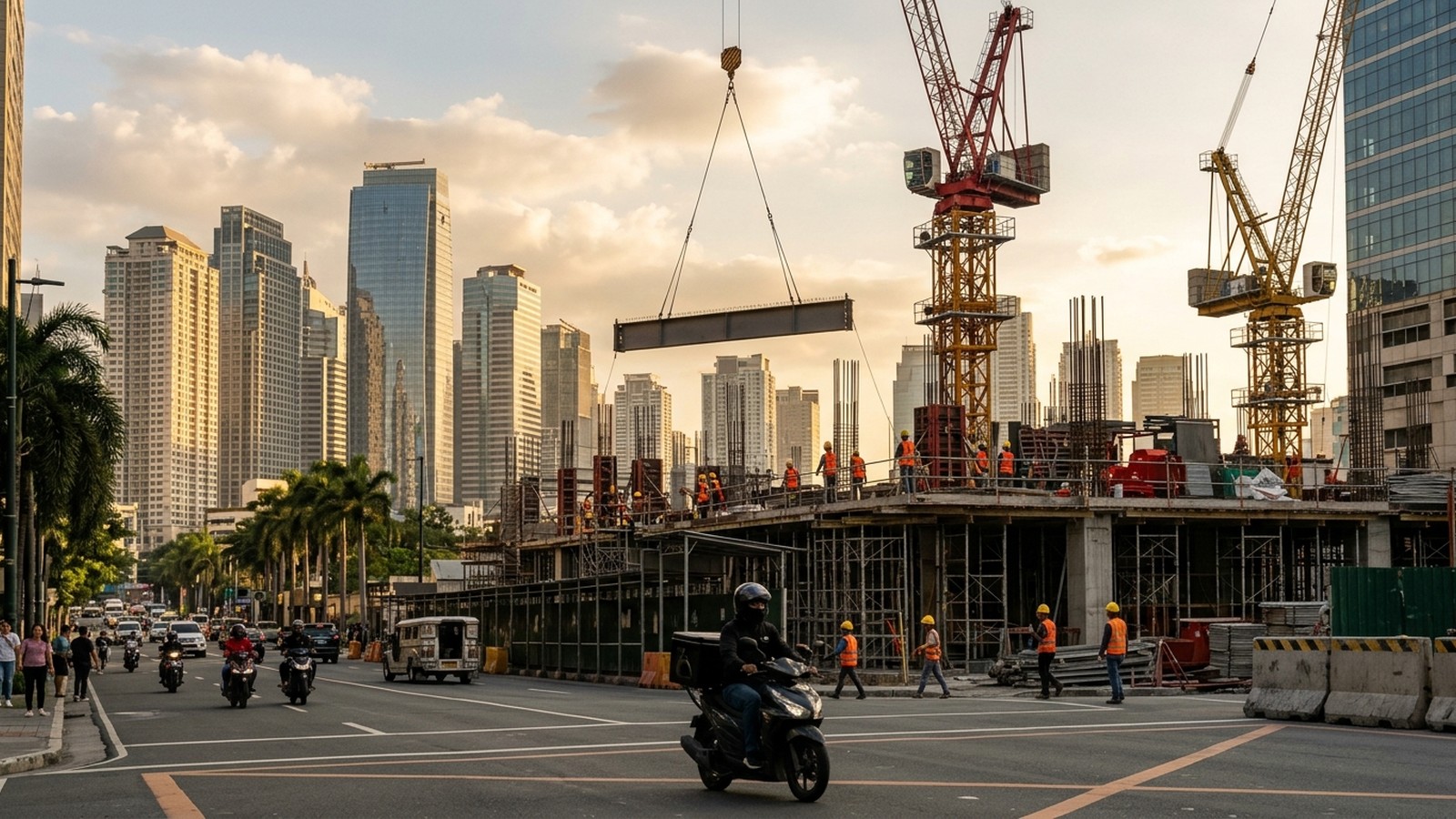
In late November 2026, Philippine economic headlines read like a split-screen broadcast. On one side, international credit analysts are marking down full-year growth expectations after months of sluggish public-works disbursements and cautious private capital spending. On the other, cabinet agencies in Manila are rolling out industrial procurement mandates, emergency-response hiring, and labor standards designed to keep domestic demand circulating through 2027.
For business owners, contractors, and gig-economy workers trying to read where policy actually lands in their day-to-day budgets, the details matter more than the headline GDP numbers.
1. The 2.4% vs. 3% Growth Debate—and Why Firms Are Pausing Expansion
Fresh downward revisions from S&P Global Ratings—trimming the Philippines’ 2026 gross domestic product outlook to 2.4%—have forced a sobering reset across boardrooms in Metro Manila and Cebu. While Socioeconomic Planning Secretary Arsenio Balisacan has maintained that full-year expansion could still finish near 3% if year-end outlays catch up, corporate sentiment remains visibly guarded.
According to BusinessWorld’s late-November corporate outlook, private companies are increasingly deferring major capital expenditures until political noise clears and household consumption shows firmer momentum. Instead of greenlighting new regional warehouses or second production lines, mid-sized firms are focusing on working-capital discipline, inventory turns, and selective hiring.
At the same time, Malacañang is pointing to targeted bright spots in services and hospitality. President Ferdinand Marcos Jr. welcomed the return and reopening of the Mandarin Oriental Hotel in Makati as a visible vote of confidence in urban tourism and high-touch service jobs, underscoring the administration’s reliance on visitor spending and commercial real estate upgrades to cushion softer manufacturing numbers.
2. Tatak Pinoy Hits Public Works: Mandatory Priority for Local Cement and Steel
One of the most concrete policy levers pulled this week targets where government infrastructure pesos actually go. Under a new Joint Administrative Order signed by the Department of Trade and Industry (DTI), the Department of Public Works and Highways (DPWH), the Department of the Interior and Local Government (DILG), and the Department of Budget and Management (DBM), national agencies, local government units (LGUs), and state-owned corporations must prioritize locally manufactured construction materials in public projects.
As detailed by the Philippine News Agency’s briefing on the procurement order, the directive operationalizes both the Tatak Pinoy (Proudly Filipino) Act and the New Government Procurement Act. Rather than letting low-cost imported cement, rebar, and structural steel capture taxpayer-funded road, bridge, and school builds, procurement bids must give structured preference to domestic manufacturers that meet quality benchmarks.
- What changes for LGU and DPWH contractors: Bid evaluations and technical specifications will increasingly require verifiable local-content sourcing for cement, steel, and core building supplies.
- The macroeconomic bet: Keeping procurement pesos inside domestic plants preserves factory shifts and freight jobs even when headline public infrastructure releases run behind schedule.
- The watch-item for developers: Contractors should audit supplier certifications early so compliance checks do not stall progress billings in 2027.
3. DILG’s ₱4.02 Billion Emergency Augmentation and Agricultural Localization
Budget priorities moving through the Senate also reflect a shift toward tangible local capacity rather than broad, unfocused outlays. During plenary deliberations on the DILG’s proposed 2027 budget, lawmakers backed a ₱4.02 billion augmentation aimed squarely at front-line disaster and emergency response.
Per PNA coverage of the Senate budget deliberations, those added funds are earmarked to recruit 2,000 additional firefighters, procure ambulances for underserved municipalities, and modernize the nationwide 911 emergency dispatch network. In a typhoon-exposed archipelago where urban density keeps rising, faster ambulance and fire dispatch times carry direct economic as well as human payoffs.
A similar localization push appeared in farm policy at the National Rice Research for Development and Extension Conference, where the Department of Agriculture (DA) pressed equipment suppliers to subject imported agricultural machinery to strict local field testing. Rather than subsidizing off-the-shelf foreign harvesters or planters that break down in muddy Philippine paddies, the DA wants proof of soil suitability, affordable spare parts, and realistic payback math for smallholder cooperatives.
4. DOLE Takes Gig and Digital Platform Protections to the ILO and ASEAN
While factories and farms navigate physical-economy rules, a growing share of Filipino households earn their primary or supplemental income through delivery riders, ride-hailing apps, and online freelance marketplaces. Representing Manila at the International Labour Organization (ILO), the Department of Labor and Employment (DOLE) called for immediate, enforceable protections for digital platform workers—not just voluntary corporate pledges.
As DOLE’s official ILO statement outlines, the Philippines is working to translate international platform-economy principles into domestic labor rules while helping steer ASEAN-wide guidelines on algorithmic transparency, social protection, and fair dispute resolution for gig workers. Alongside the Department of Migrant Workers (DMW) cautiously weighing a tightly screened government-to-government resumption of hotel-staff deployments to Israel subject to security clearance, labor policy is clearly tilting toward formalizing precarious work.
What to Watch Heading Into 2027
Whether Philippine growth finishes closer to 2.4% or nudges toward 3% will hinge less on speeches than on execution speed: how fast the DBM and DPWH clear procurement bottlenecks under the new Tatak Pinoy rules, whether private firms regain enough certainty to unfreeze expansion budgets, and how cleanly DOLE turns international gig-economy principles into enforceable protections for millions of app-based workers.
Sources & Further Reading
- BusinessWorld — Philippine Firms Seen Deferring Expansion Plans Amid Political Uncertainty (Nov 26, 2026)
- Philippine News Agency — Agencies Sign Tatak Pinoy Joint Order Supporting Local Construction Materials
- Philippine News Agency — DILG Receives ₱4.02B Senate Budget Augmentation for Emergency Response
- DOLE — Philippines Pushes Stronger Protections for Digital Platform Workers at the ILO